

Ethereum in 2025: Shocking Evolution Beyond Merge
Ethereum in 2025?
Table of Contents
The Ethereum Merge was more than a tech upgrade; it was a statement of intent. By transitioning from energy-intensive Proof-of-Work to the sleek, staking-based Proof-of-Stake, Ethereum laid a new foundation for its future. But in the fast-moving world of crypto, resting on your laurels isn’t an option. The core developers and community are already building the next chapters, focused on one thing: mass adoption through scalability, security, and a seamless user experience.
If you’re just catching up, our guide on the emerging tech trends of 2025 provides a great big-picture context for innovations like these.
The Scalability Trinity: How Ethereum Plans to Become Ultra-Cheap and Fast
The “Blockchain Trilemma” of achieving scalability, security, and decentralization simultaneously has been Ethereum’s primary challenge. The roadmap for 2025 tackles this head-on with a multi-layered approach.
1. The Surge: Proto-Danksharding is a Game-Changer
You’ve likely heard of “Ethereum 2.0” or “The Surge.” The most critical immediate upgrade within this phase is Proto-Danksharding (EIP-4844). Think of it as building a high-capacity carpool lane on a busy highway.
- What it is: Instead of storing all transaction data on-chain forever, Proto-Danksharding introduces “data blobs”—temporary data packets that rollups (like Arbitrum and Optimism) can use.
- The Impact: This drastically reduces the cost for Layer 2s to post data to the mainnet. The result? Drastically lower transaction fees for end-users, potentially bringing costs down to cents per transaction. This is a pivotal step towards making Ethereum viable for everyday micro-transactions.
Looking ahead to Ethereum in 2025, the full implementation of Danksharding will be the culmination of “The Surge.” This will expand those data “carpool lanes” into a massive, multi-lane data highway, allowing the network to process over 100,000 transactions per second. This level of scalability is what will finally allow Ethereum in 2025 to support global, consumer-level applications like fully on-chain video games and complex DeFi protocols for millions of users simultaneously, all while maintaining its foundational security.
Furthermore, the vision for Ethereum in 2025 is not just a single, monolithic chain but a cohesive, modular ecosystem. In this future, the mainnet acts as a secure settlement and data-availability layer, while Layer 2s handle general-purpose scaling, and specialized Layer 3s cater to specific applications. This interconnected stack is the true endgame for scalability, ensuring that Ethereum in 2025 can be all things to all applications—secure, decentralized, and incredibly fast.
For a deeper understanding of how such foundational tech works, platforms like Binance.com offer excellent educational resources on blockchain fundamentals.
2. The Rise of Layer 3: The Specialist App-Chains
We’ve grown accustomed to Layer 2 solutions for scaling. The next evolution is Layer 3s (L3s). If Layer 2s are general-purpose scaling solutions (a whole city’s infrastructure), Layer 3s are custom-built, application-specific chains (a specialized factory within that city).
- Customization: An L3 can be hyper-optimized for a single dApp’s needs—whether it’s a game requiring millions of transactions per second or a social media platform needing zero-gas-fee interactions.
- Benefits: This creates an environment where developers have maximum flexibility, pushing the boundaries of what’s possible on-chain without congesting the underlying layers.
Beyond the immediate gains in scalability, the broader Ethereum Roadmap includes crucial phases like “The Scourge,” which is dedicated to tackling Miner/Maximal Extractable Value (MEV) and ensuring fair and decentralized block production. This is a critical component of the Ethereum Roadmap that often goes underappreciated, as it directly addresses economic fairness and censorship resistance on the network. By solving these complex economic issues, the Ethereum Roadmap ensures the chain remains a level playing field for all participants, which is fundamental for long-term trust and adoption.
Another pivotal phase outlined in the Ethereum Roadmap is “The Verge,” which will introduce Verkle Trees. This upgrade is a monumental step for node operators, as it will allow them to sync with the network without needing to store immense amounts of historical data. This will drastically lower the hardware requirements for running a node, further decentralizing the network and strengthening its security. The inclusion of “The Verge” in the comprehensive Ethereum Roadmap highlights a commitment to not just scaling for users, but also for the health and resilience of the underlying infrastructure itself.
User Experience Revolution: Making Crypto Invisible
The next wave of adoption won’t come from tech-savvy degens alone; it will come from everyday users who don’t know (or care) what a seed phrase is. Ethereum is focusing heavily on this.
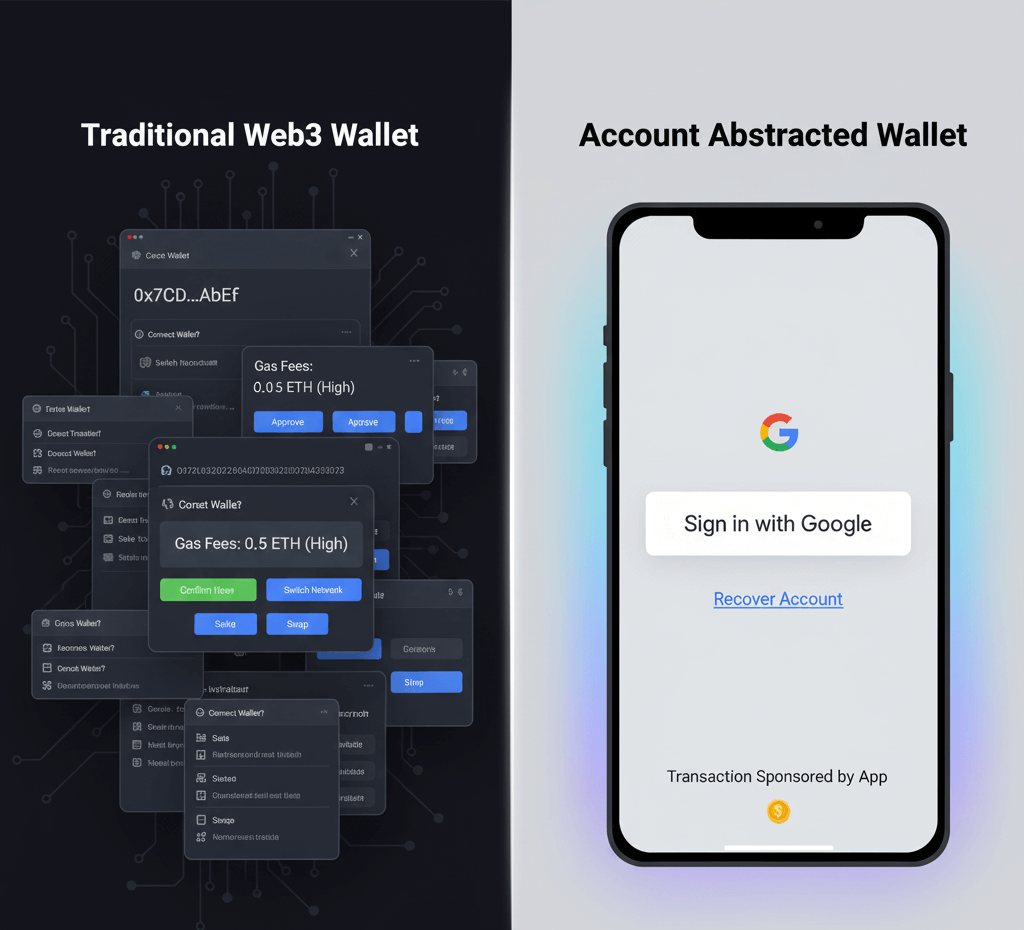
Account Abstraction (ERC-4337): Your Smart Contract Wallet
Imagine a crypto wallet that works like your bank app. You can recover it with an email, set spending limits, and pay fees in the token you’re transacting with. This is the promise of Account Abstraction.
- Social Recovery: Lose your phone? No problem. Use “guardians” (like friends or other devices) to recover your wallet securely.
- Sponsored Transactions: dApp developers can pay for users’ gas fees, creating a frictionless onboarding experience, much like web2.
- Batch Operations: Approve and execute multiple transactions in one click, saving time and money.
This shift towards a more intuitive user interface is part of a broader trend in tech, moving towards what we’ve termed the Agentic Organization work in the AI era, where systems work proactively on the user’s behalf.
The Verdict: Is Ethereum’s Future Secure?
With this ambitious roadmap, Ethereum is not just solving for today’s problems but anticipating tomorrow’s needs. The focus is shifting from raw throughput to a holistic ecosystem where scalability, security, and user experience are in harmony.
While competitors exist, Ethereum’s first-mover advantage, massive developer community, and now, its clear, iterative upgrade path, give it a formidable edge. The journey from a monolithic blockchain to a modular, interconnected ecosystem is well underway.
To stay ahead of the curve in the crypto world, keeping an eye on major exchange announcements and reports from sources like Binance.com is crucial, as they often list and support the new tokens and projects born from these technological shifts.
Conclusion: An Ecosystem Poised for Growth
The post-Merge era is proving to be the most exciting phase in Ethereum’s history. With Proto-Danksharding set to slash fees, Layer 3s enabling unprecedented specialization, and Account Abstraction removing the final barriers for users, Ethereum is systematically building the platform for the next generation of the internet.
The future is modular, scalable, and, most importantly, user-friendly.
Ready to dive deeper into the world of blockchain and tech? We’re always exploring the next big thing.
(For a full list of our insights, check out all our Crypto posts and Tech posts.)
